
Inside Somerset Tax Records
Two offices split the work in Somerset County. The Maryland SDAT Real Property Search maintains the assessment side: owner display, land and improvement values, use data, and parcel keys. Somerset County Finance handles billing, payment, and collection. Keep the division straight. An SDAT value is the assessment input, not the amount owed on a county bill.
| Field | What It Shows | Where |
|---|---|---|
| Land, improvement, and total values | The components and total recorded for assessment | Maryland SDAT parcel card |
| Owner and mailing address | The name and tax-mail destination on the roll | Maryland SDAT parcel card |
| Account and map references | District, account, map, grid, and parcel keys | SDAT and county records |
| Credits or exemptions | Relief that may change taxable liability | SDAT program records and bill |
| Bill and payment status | Charges, payments, balance, and delinquency | Somerset Finance and WIPP |
Never treat an assessed value as a sale price. SDAT estimates fair market value through sales, cost, and income approaches, while a deed may record actual consideration from a transfer. The tax bill then layers rates and relief onto the taxable base. Three different numbers, three different jobs. Read them in context rather than swapping one for another.
Start With the SDAT Account
Begin in SDAT by choosing Somerset County, then pick a search method. Maryland's own instructions list the valid routes: address, street name, account identifier, and map reference. Owner name, ZIP, town, subdivision, and neighborhood will not work as direct keys. That limitation bites when you hold nothing but a taxpayer's name. The fix is to recover the premises address or map reference first. You can also trace the parcel through the deed index. Then return to the assessment search.
| Search route | Best input | Somerset use |
|---|---|---|
| Address | Street number and street name | Best for a known situs address |
| Street name | Name, with a wildcard if needed | Useful when the number or suffix fails |
| Account | District and account identifier | Preserves leading zeroes and narrows the result |
| Map reference | Map, grid, and parcel fields | Connects planning and tax documents |
A Somerset result shows why exact copying matters. Its fields run separately: District 01, Account Identifier 007122, Map 015C, Grid 0015, Parcel 0009. Resist squeezing those into an invented universal APN format. Copy each label and value just as displayed. Then give Finance both the account identifier and the full property address.
Note: SDAT bars automated collection, so use the public search as intended and keep a dated copy of any result.
Read Somerset Assessment Fields
A typical parcel card lists land value, improvement value, and a total. Land covers the site itself. Improvements mean buildings and other qualifying structures. The total merges both into the assessment record. For authoritative wording, the Maryland real-property glossary gives official definitions, and the homeowner guide explains how valuation, phase-in, credits, and the tax calculation fit together.
A principal-residence flag also appears on the record. A "NO" there is not proof of where a person lives. An out-of-county mailing address proves nothing either. The premises address locates the assessed property; the mailing address simply routes tax correspondence. Companies, estates, trustees, and remote owners have many valid reasons for differing mail addresses.
Somerset's Three-Year Value Cycle
Maryland reassesses real property on a three-year cycle. About one-third of the state's accounts enter a new cycle annually. SDAT then certifies assessments to local governments. The notice year, phase-in rules, and applicable credits all shape the final bill, so comparing two tax years takes more than eyeballing the totals.
SDAT's December 2025 statewide release described 2026 reassessment growth as slower than the prior cycle. That report is useful background. It is no substitute for a Somerset parcel notice. For parcel-level work, save the actual assessment notice and the SDAT worksheet. Together they show the record under contest and fix the start of the appeal period.
Ratio caution. Somerset's 2025 weighted assessment ratio was reported at 94.5 percent, but that statistic is not a discount or a parcel appraisal.
Look Up a Somerset Tax Bill
The county ties its tax work to WIPP, but that application depends on browser scripts and may not render fully for every visitor, so its current labels and result fields vary. Assume nothing about exports, owner search, or history tools until the screen shows them. The dependable route is the Somerset County Tax Collections office at 11916 Somerset Avenue, Room 116, Princess Anne, MD 21853, 410-651-0440.
- Find the parcel in SDAT and copy the district, account identifier, map, grid, parcel, and premises address.
- Open the county-linked WIPP application. If it does not load or the fields are unclear, call Finance with the copied identifiers.
- Match the bill year and property identity. Review charges, credits, payments, balance, and any delinquent notation that the live record exposes.
- Compare the owner and assessment fields with SDAT. For a recent transfer, confirm the latest deed rather than assuming every system updated together.
- Assessed value
- The official value used as a starting point for taxation, subject to Maryland rules and phase-in.
- Tax rate or levy
- The rate local government applies to the taxable assessment.
- Homestead credit
- A program that may limit growth in taxable assessment for a qualifying principal residence.
- Tax lien
- A legal claim tied to unpaid property tax; it is not itself proof that title has transferred.
Hold onto the confirmation number or receipt after any payment. A stale owner name does not erase the tax obligation attached to the parcel, and a fresh payment may take time to post. When timing matters, ask Finance for the "as of" date on the record.
Credits and Somerset Tax Relief
Maryland keeps exemptions and credits distinct. The SDAT exemption directory covers qualifying disabled veterans, blind individuals, charitable or religious property, government property. It also covers certain medical or institutional uses. The tax-credit directory gathers homeowner and other relief programs. Eligibility turns on ownership, use, income, disability, service status, or filing facts.
Match any application or approval to the right account and tax year. A principal-residence indicator alone never proves that every credit was granted. When a credit seems missing, compare the decision notice. Compare the SDAT record and the Somerset bill side by side. Then ask the correct office to fix the correct system.
Tax Sale Is Not a Deed
Unpaid Somerset property tax can push a parcel into Maryland's tax-sale process. The state's tax-sale schedule listed Somerset sale dates in both 2025 and 2026. Its tax-sale explanation covers the advertisements that precede a sale. Those ads may name the owner, the property, and the tax owed. That is all they prove.
A sale notice is not a deed. Redemption rights and later court steps can intervene before a purchaser receives title. Verify the account with Finance. Match the ad to its stated year and amount. Search Maryland court and land records for anything filed later. The latest recorded deed remains the key ownership document.
Note: Never pay from a solicitation alone. Confirm the parcel and amount through the official county contact.
Appeal a Somerset Assessment
An assessment appeal starts with the notice, not the tax bill. Maryland allows written, telephone, video, or in-person first-level hearings. The deadline is tight. A first appeal generally must be filed within 45 days of the notice date. The online appeal form asks for the county, Notice Number, and Control Number. Keep the original notice intact.
Good evidence is property-specific. Bring the SDAT worksheet, accurate building facts, dated photographs, comparable sales, repair records, and a survey or plat where land area is disputed. Disliking the tax amount is not itself proof the assessment is wrong. An adverse first-level result can move to the Property Tax Assessment Appeal Board, then to the Maryland Tax Court where allowed, under the official appeal process.
The official Somerset assessment-appeal screen shows the entry route. It starts with the notice.
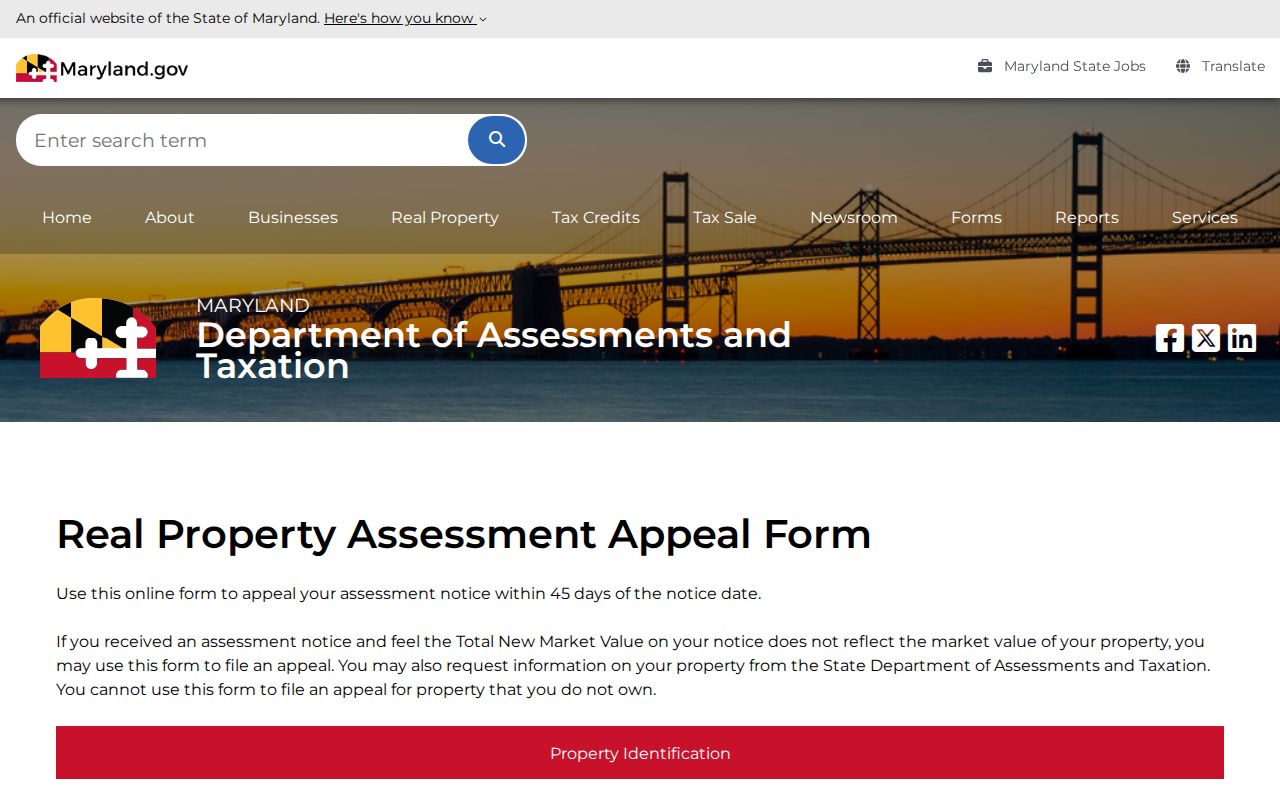
The county appeal form asks for the county name, a notice number, and a control number. Those fields identify the account. They do not decide eligibility or replace the instructions printed on the notice.
Before filing, separate factual corrections from valuation arguments. A wrong building size, land area, use, or parcel match calls for proof. The proof should show the correct fact. A value argument needs comparable market evidence tied to the valuation date. Organize exhibits by source and date, and keep a full copy of the submission. If the issue is a missing credit rather than the assessment itself, use the credit program's own review route. Ask which agency can correct the affected tax year.
Protect the deadline. File the first appeal within 45 days of the assessment notice date and use the notice and control numbers shown on that notice.
When Tax and Deed Records Differ
A fresh closing often shows up in Land Records before the owner name changes on SDAT or a county tax display. The timing gap is normal. Compare the newest recorded deed, its recording date, the SDAT "as of" information, and the bill year. The deed confirms the new grantee. An older bill may still name the prior taxpayer. Ask Finance how to direct payment and correspondence rather than treating an old name as proof of present title.
Credits hit the same timing problem. A prior owner's benefit may not transfer. A new owner may need a separate application. Fix parcel identity first, then address the owner, mailing address, credit, or payment field in the system that maintains it. Keep the closing papers, the recorded deed reference, and the assessment account handy when contacting either office.