
Trace Somerset County Former Owners Backward
A former-owner search moves against the direction of conveyance. Open the current deed first. Identify the grantor, then locate the earlier deed by which that same grantor received the identical land. Repeat the step only after the legal description, acreage, lot, tract, adjoining owners or plat reference confirms the match, because a shared surname alone proves nothing.
| Backward link | Coverage | Custodian | Evidence to carry back |
|---|---|---|---|
| Current deed reference | Current parcel | SDAT | Book/page lead and land identifiers |
| Current and recent deeds | Live system; verify cutoff | Somerset Circuit Clerk / MDLandRec | Grantor, grantee, dates and legal description |
| Original grantee index | 1665-1995 | MSA CE228 | Historic acquisition citations |
| Original grantor index | 1665-1993 | MSA CE229 | Historic conveyance citations |
| Assessment ledgers | 1793-1917 series | Maryland State Archives | Supporting owner-by-year trail |
These sources form a timeline, not one all-years database. Index, image, microfilm and original record are separate access layers, and the current image cutoff at Maryland Land Records must be checked live before relying on any date range.
Start with Somerset's Book-and-Page Link
The Princess Anne assessment card lists Deed Reference /01043/00020. Copy that reference along with the Owner Name. Add Map 015C, Grid 0015, Parcel 0009 and the legal description. Then open Maryland Land Records. From the deed itself, record both parties, execution and recording dates, consideration, lot or acreage, tract or subdivision, exceptions and any earlier vesting citation. The portal does not search by modern address or parcel number. Party names and book/page citations are the bridge. Every detail copied now saves a repeat trip later.
Go Back Through Somerset's 1665 Index Runs
The CE228 finding aid covers Somerset's original grantee index from 1665 through 1995. The companion CE229 grantor index spans 1665 through 1993. Each index runs as year-and-letter image sets. The 1665-1876 period offers broad A-L and M-Z runs, with narrower surname ranges in later years. No parcel search exists here. Copy the entry's liber and folio. Initials, reordered names and spelling errors can hide previous owners, so try close variants and accept a match only when the land description agrees.
See Somerset's Reverse Grantor Index
The Archives' original grantor-index page demonstrates the access point for tracing prior transfers.
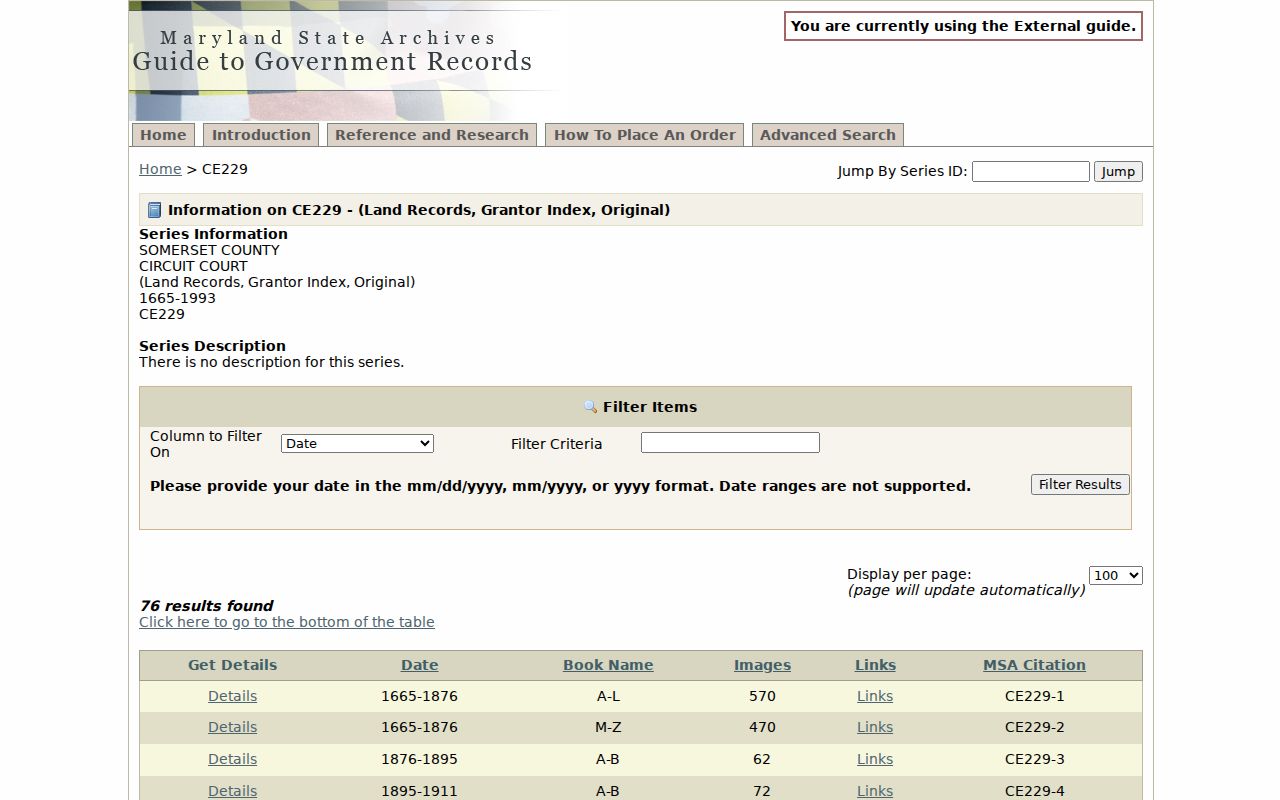
Year-and-letter runs reward preparation. Bring a party name and an approximate period, and the cited deed becomes retrievable; without them, the reverse grantor index stays a maze of images.
Bridge a Chain Gap at the Somerset Courthouse
A missing web image does not break the chain. The Circuit Court for Somerset County keeps a Land Records research room at 30512 Prince William Street in Princess Anne, generally open Monday through Friday, 8:30 a.m. to 4:30 p.m. Call 410-845-4840 with a name, approximate year and citation. Public terminals, deed books, microfilm and Archives series offer alternate routes, with copies available for a fee. Staff cannot run a title search or decide which deed applies. Ordinary copies run $0.50 per page. Certification and other charges follow the current official schedule.
Reconstruct Somerset's Deed Chain Step by Step
Work from the supported recent record into the past and preserve every citation.
- Find the precise parcel in SDAT and copy the current deed reference and identifiers.
- Read that deed for grantor, grantee and matching legal description.
- Search the grantor as an earlier grantee, narrowing by year and name variant.
- Open the cited instrument, verify the same land and repeat.
- Grantor
- The party conveying the stated interest.
- Grantee
- The party receiving the stated interest.
- Chain of title
- The ordered sequence of matching conveyances.
- Liber / folio
- Historic terms for deed book and page.
Follow Somerset Estates and Reconfigured Lots
Inheritance can break a simple seller-to-buyer sequence. Archives holdings include administration indexes, estate dockets, wills, inventories and accounts. Search the decedent and the fiduciary. Then locate any executor's, trustee's or distribution deed in Land Records. Probate supplies context; the recorded instrument carries the chain. A plat can reconnect land after a layout change. Somerset's S1253 subdivision series covers 1945 through 1993 and names Princess Anne Villas, Jacksonville East Section 2, Harbor View and other developments. PLATS.NET serves the statewide images; match lot, section and deed references, and remember a plat is not a current boundary survey.
Use Somerset Ledgers and Newspapers as a Second Trail
Historical assessment ledgers can bridge a difficult owner interval. A tax name supports the story without proving a conveyance. Somerset Library newspapers add estate sales, courthouse auctions, subdivision advertisements and obituaries. Holdings include the Crisfield Times from 1907. They also hold the Marylander and Herald from 1912 and several Somerset Herald runs, with documented gaps. The Crisfield, Ewell and Princess Anne branches offer in-library genealogy databases. They also carry census material from 1790. Ask about print holdings and microfilm there. A local collection often reaches further than any online index suggests.
Use Somerset Ledgers and Newspapers as a Second Trail
Old tax ledgers can bridge a stubborn gap between owners, but a ledger name is only supporting evidence, never a conveyance. The Somerset Library collection carries estate sales, courthouse auctions, subdivision advertisements and obituaries. Its holdings include the Crisfield Times from 1907, the Marylander and Herald from 1912, and several Somerset Herald runs, all with documented gaps. The Crisfield, Ewell and Princess Anne branches also offer in-library genealogy databases and census material reaching back to 1790. Ask about print holdings and microfilm. Local sources often sit outside any online listing.
A newspaper notice can hand you the tract phrase, auction date, fiduciary, adjoining landowner or courthouse-sale terms. That detail sends you back to the deed index. Record the newspaper title, issue date and page. The library lists gaps and overlapping runs, so never call any title continuous without checking the issue itself. Somerset's Archives materials add Board of Registry records from 1865-1932, poll books from 1834-1857 and early county court records. These sources connect people to a community or era. They cannot replace the conveyance. For African American landholding research, certificates of freedom and special-collection material may explain a historical identity when the land index offers only a name variant.
Old assessment records demand the same discipline as deeds. Copy district, owner spelling, acreage, assessed items and year. One person can own several tracts. A tax entry may persist for years after an event has passed. Compare neighboring years and find the recorded instrument that explains the change.
Corporate grantors need their own approach. Search the exact business name and every variant. A subdivision developer may convey many similar lots, so the legal description and plat reference are decisive. Tidewater Realty Company is a documented Crisfield plat-search term. Miles & Hargis serves as both a Princess Anne subdivision and annexation clue. Neither name alone identifies the subject lot. Rural tracts reward patience. Metes-and-bounds calls, acreage, waterways and adjoining owners often outlast a road address. Transcribe those calls rather than paraphrasing them. Note whether a later deed describes only part of the earlier tract. A split, combination, resubdivision or road dedication can make one older deed branch into several modern parcels.
Know How Far Somerset Ownership Research Reaches
Somerset County land records reach back to 1665. Both original index series start in that year. Readable online images are not guaranteed for every volume. Older court-land series, microfilm and original volumes may still be needed. A reconstructed list of former owners is no substitute for a professional title opinion. When a citation is unclear, verify it with the custodian.
A chain worksheet helps. Give each instrument its own row: grantor, grantee, deed date, recording date, book/page, consideration, land description and source image. Mark an unresolved jump instead of quietly linking two names. If the land description shifts, decide whether the deed conveys a part, remainder, combined tract or correction. Then work further backward.
Somerset court-land volumes 4 and 5, covering 1698-1725, show a transcript gap in the Thurgood Marshall Law Library catalog. That gap in the catalog does not mean the original land evidence is gone. Check the original indexes, Archives series and custodian holdings instead of inserting an assumed owner into the interval.
Lawful historical use. Trace prior owners for house history, estates and property diligence. Do not use public records to stalk, harass or harm a living person.